The Mathematical Reality Behind Exchange Superiority
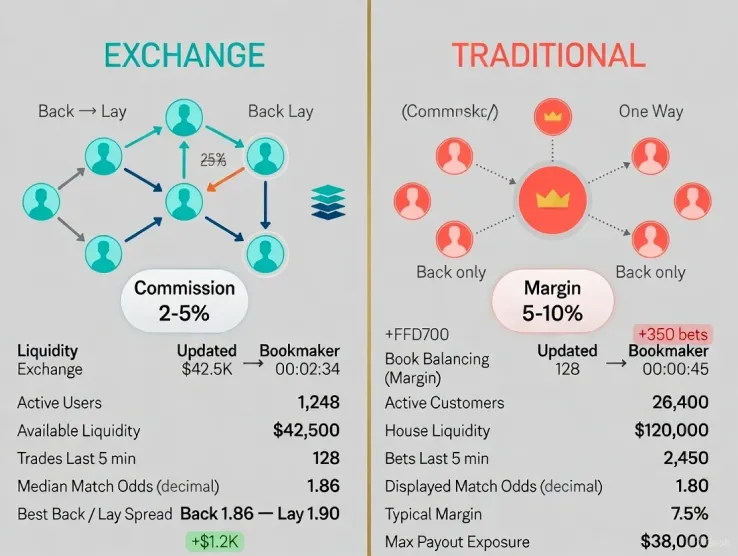
When professional gamblers and sharp players discuss their edge over the house, the conversation inevitably turns to betting exchanges versus traditional bookmakers. The numbers don’t lie: while traditional sportsbooks maintain margins of 4-8% on most markets, betting exchanges operate with commission structures averaging just 2-5% on winning bets. This fundamental difference creates a seismic shift in long-term profitability for skilled players.
Consider the Premier League match odds market in early 2026. Traditional bookmakers like William Hill offered Manchester City at 1.85 to beat Tottenham, building in their standard 5.2% margin. Meanwhile, on Betfair Exchange, the same outcome traded at 1.91 – a difference that compounds dramatically over hundreds of bets. For a sharp player wagering £10,000 monthly, this margin differential translates to approximately £3,600 additional profit annually.
The exchange model fundamentally alters the relationship between player and platform. Instead of betting against the house edge, you’re trading against other punters while paying a small commission only on profits. Platforms like 22Bet have recognized this shift, offering both traditional sportsbook and exchange-style markets to cater to different player preferences and skill levels.
Liquidity Dynamics and Market Efficiency Gaps
Professional trader Marcus Chen, who manages a £2.8 million sports betting portfolio, explains: “Traditional bookmakers are essentially retail operations – they set prices based on broad market sentiment and liability management. Exchanges reflect true market prices through supply and demand, creating arbitrage opportunities that simply don’t exist in fixed-odds betting.”
The liquidity on major exchanges has reached unprecedented levels in 2026. Betfair’s Premier League markets routinely see over £15 million matched per fixture, while Champions League finals can exceed £100 million in total volume. This depth allows sharp players to execute large positions without significant price movement – impossible with traditional bookmakers who limit successful players or void bets entirely.
However, liquidity varies dramatically across markets. While top-tier football and tennis offer exceptional depth, niche sports or lower-league competitions may have insufficient volume for serious players. Exchange trading requires understanding these liquidity patterns and timing entries accordingly.
The Lay Betting Revolution
Perhaps the most game-changing feature of betting exchanges is the ability to lay outcomes – essentially acting as the bookmaker yourself. This functionality opens strategies impossible in traditional betting: hedging positions mid-game, trading price movements, and creating synthetic arbitrage opportunities.
Data from Betdaq shows that successful exchange players utilize lay betting for 35% of their total volume, compared to zero possibility with traditional bookmakers. The psychological shift is profound: instead of hoping your selection wins, you can profit from any outcome through strategic position management.
Take the 2026 Australian Open men’s final between Djokovic and Sinner. Sharp players backed Djokovic at 2.20 pre-match, then laid him at 1.45 when he won the first set, guaranteeing profit regardless of the final result. Traditional bookmaker customers had no such flexibility – they were locked into their initial position until settlement.
Commission Structures That Reward Skill
Exchange commission models inherently favor skilled players over recreational punters. Most exchanges charge 2-5% commission only on net winnings, meaning losing bets cost nothing beyond the stake. Additionally, many exchanges offer reduced commission rates for high-volume players – Betfair’s Premium Charge affects less than 0.05% of customers but generates significant revenue from the most successful traders.
This creates a virtuous cycle for sharp players. As your skills improve and volume increases, your effective commission rate decreases. Contrast this with traditional bookmakers who actively restrict or ban winning players. Exchange expert Sarah Williams, author of “Professional Exchange Trading,” notes: “I’ve seen players go from 5% standard commission to 2% premium rates, effectively doubling their edge over recreational exchange users.”
The transparency of exchange pricing also eliminates the hidden margins built into traditional odds. Every price movement, every matched bet, every commission charge is visible in real-time. This transparency allows sophisticated modeling and strategy development impossible in the black-box world of traditional bookmaking.
Speed and Technology Advantages
Modern betting exchanges operate with latencies measured in milliseconds, crucial for in-play trading strategies. API access allows algorithmic trading, automated hedging, and real-time portfolio management. Traditional bookmakers typically restrict API access and often delay or reject bets from successful automated systems.
The technological infrastructure supporting exchanges has evolved dramatically. Betfair processes over 7 million transactions daily with 99.99% uptime, while offering mobile apps that execute trades faster than most traditional bookmaker websites can load. For players implementing complex strategies across multiple markets, this speed differential is often the difference between profit and loss.
However, this technological sophistication comes with a learning curve. Exchange interfaces are more complex than traditional betting slips, requiring understanding of backing, laying, price movements, and liquidity management. Many sharp players invest months learning exchange mechanics before achieving consistent profitability.
Risk Management Through Position Trading
Traditional bookmakers force binary outcomes – your bet either wins or loses. Exchanges enable continuous risk management through position trading, allowing players to lock in profits, minimize losses, or adjust exposure as events unfold.
Consider a tennis match where you’ve backed the underdog at 4.0. If they win the first set, their odds might shorten to 2.5. On an exchange, you can lay at 2.5 to guarantee profit regardless of the final result. Traditional bookmaker customers must ride their original bet to completion, unable to capitalize on favorable price movements.
Professional exchange traders often maintain dozens of active positions across multiple sports, constantly adjusting exposure based on price movements, news, and in-game developments. This dynamic approach to risk management is simply impossible with traditional fixed-odds betting.
Market Making Opportunities for Advanced Players
The most sophisticated exchange users don’t just take prices – they make them. By offering odds on both sides of a market, skilled traders can profit from the bid-ask spread while providing liquidity to other users. This market-making function is exclusive to exchanges and represents the highest level of sports trading sophistication.
Data from Smarkets indicates that approximately 12% of exchange volume comes from market makers who profit regardless of sporting outcomes. These players have evolved beyond traditional gambling into pure financial trading, using sports events as underlying assets for price discovery and spread capture.
The barriers to entry for market making are significant – requiring substantial capital, sophisticated modeling, and deep understanding of probability theory. However, successful market makers often achieve annual returns exceeding 20% with lower volatility than directional betting strategies.
Global Access and Regulatory Advantages
Betting exchanges often operate under different regulatory frameworks than traditional bookmakers, providing access to markets and betting types unavailable elsewhere. The peer-to-peer model faces fewer restrictions in many jurisdictions, allowing players in regulated markets to access global liquidity pools.
Exchange regulation has matured significantly by 2026, with major platforms holding licenses in over 15 jurisdictions. This regulatory clarity provides confidence for serious players managing large bankrolls, while the international nature of exchange liquidity creates opportunities unavailable in domestic-only markets.
For sharp players, the combination of better odds, advanced functionality, and global market access makes betting exchanges the clear choice over traditional bookmakers. While the learning curve is steeper and the interface more complex, the mathematical advantages are undeniable for anyone serious about long-term profitability in sports betting.
No Responses